
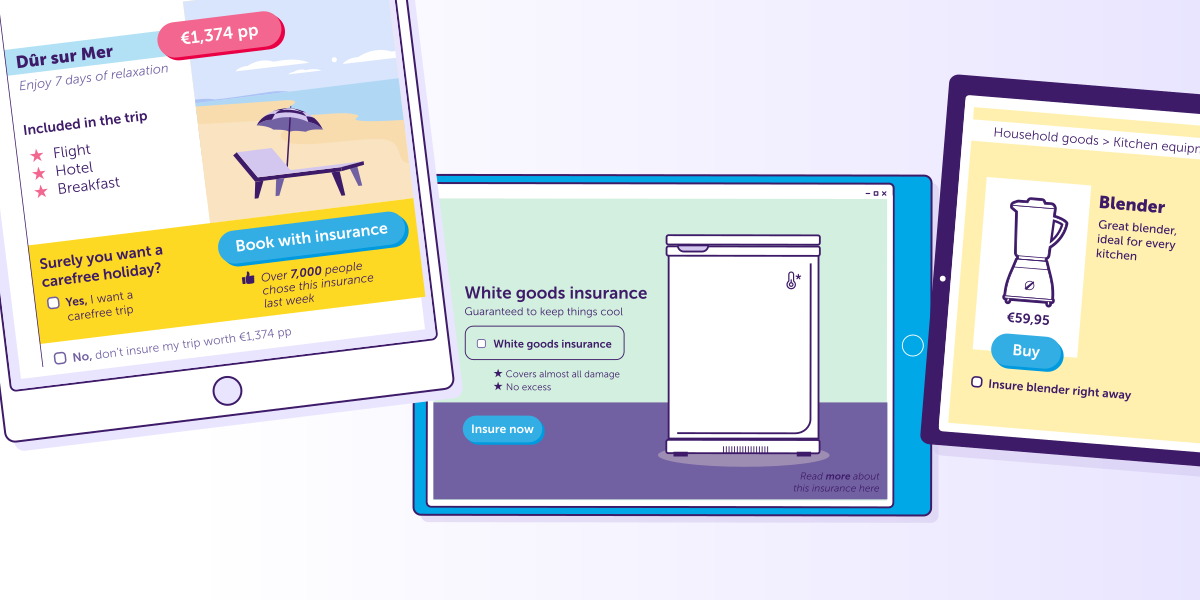
Strong steering towards embedded insurance increases the risk of unsuitable consumer choices
The design of online choice environments on platforms offering embedded insurance increases the risk that consumers will take out insurance that is not appropriate for their situation, for example because the cover overlaps with existing insurance policies. During the purchase process for a product or service, consumers are often steered towards taking out insurance in multiple ways, while they do not always receive sufficient information to make an informed decision. This is evident from new research by the Netherlands Authority for the Financial Markets (AFM). We therefore call on providers and platforms to design their choice environments carefully so that consumers can make appropriate choices.
In short
- Multiple elements jointly steer consumers towards taking out insurance
- Degree of steering increases the risk of consumers choosing an inappropriate product
- The AFM calls for the careful design of online choice environments
Embedded insurance is insurance that is offered during the purchase of another product or service, often on (online) non-financial platforms. Examples include insurance offered as an additional option when purchasing a plane ticket, bicycle, television or festival ticket. The AFM previously examined the opportunities and risks of embedded insurance. When carefully designed and transparently offered, embedded insurance can provide consumers with convenience and relevant protection at the moment they need it.
AFM Executive Board Member Jos Heuvelman said: “Consumers are being steered quite strongly towards taking out insurance in these choice environments, even though such insurance is not always appropriate for their individual situation. This creates a risk of overinsurance. Without clear information and a balanced presentation of options, consumers cannot make an informed decision. That needs to change. Providers and platforms must design their choice environments more carefully.”
Multiple elements jointly steer consumers towards taking out insurance
Although the degree and form of steering vary by platform, the AFM’s observation of 22 online choice environments shows that platforms often apply a combination of elements that encourage consumers to take out insurance.
In many cases, taking out insurance is a low-friction process, insurance products are prominently and repeatedly brought to the consumer’s attention, and the option not to insure is presented in a less visible or less accessible manner. Many platforms also use additional behavioral triggers, such as an emphasis on security and protection, social proof (for example, “most popular choice”) and time pressure during the purchase process. These elements may encourage consumers to make quick decisions and steer them towards taking out insurance.
The AFM also finds that information is generally presented in layers, with information in the top layer often being limited and underlying information frequently complex and difficult to access. On the main page, the emphasis is usually on the benefits of the insurance, while important information about limitations, duration, costs and possible overlap with existing insurance policies is less visible or harder to find. This may result in consumers making choices based on an incomplete and one-sided picture.
Degree of steering increases the risk of consumers choosing an inappropriate product
Because the cover provided by embedded insurance is often closely related to the product or service with which it is purchased, that cover may overlap with insurance policies consumers already have, resulting in overinsurance. The current degree of steering in online choice environments takes little or no account of this risk, thereby increasing the likelihood that consumers will end up with insurance that is not appropriate for their situation.
Call for a careful design of choice environments
Although the AFM did not assess compliance with statutory requirements in this exploratory study, the design of a choice environment may result in providers and/or platforms not complying with legal standards enforceable by the AFM.
The AFM calls on providers and platforms to design their online choice environments carefully so that consumers are better supported in making choices that are appropriate for their situation. This includes ensuring that information is clear and accessible and that options are presented in a balanced manner. The report contains further recommendations for platforms and providers offering embedded insurance.
Contact for this article

06 11 64 22 77
Would you like to receive the latest news from AFM?
Subscribe to our newsletter, we will keep you up-to-date.