Trend Monitor
The AFM Trend Monitor highlights key trends and related risks in the financial sector. It provides context, detailed insights, and explains how these topics connect.
Trend Monitor 2027



Please note: 'Trend Monitor 2027' reflects the current state of affairs as of October 28, 2026. Developments after this date are not included in this publication.
Examples of trends and risks by area of supervision
Financial services
More pensioners receive variable benefits
The new pension system requires dierent communication strategies. In recent years, the pension sector has put a lot of energy into informing participants about the conversion of pension rights and the consequences of this for their personal situation. Both for participants whose pensions have yet to be transferred to the new pension system and for those who have already switched, it is important that pension providers present a realistic picture of what participants can expect from their pension. This includes the consequences of a pension benefit that becomes variable and can therefore be adjusted annually.
Full preservation of purchasing power and the prevention of nominal reductions are at odds with each other. There is always a trade-off between the amount of the initial benefit, the stability of the benefit and the degree of preservation of purchasing power. For example, incurring more investment risk can contribute to maintaining purchasing power, but it also makes pension benefits more sensitive to headwinds in the financial markets.
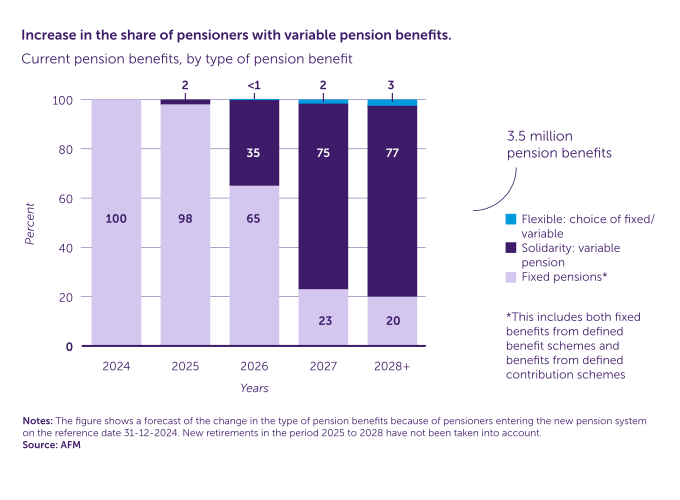
The variable pension benefit will become the dominant form of benefit payment in the coming years. On 1 January 2026, approximately 35% of all pension benefits in the Netherlands were variable benefits. The share of variable benefits is expected to rise to 75% on 1 January 2027. As soon as all pension funds that intend to convert have switched to the new pension system, almost 80% of the
benefits will be variable. For the majority of pensioners, the variable pension benefit, and the way in which the pension benefit responds to various market developments, is new.
As millions of Dutch people have variable pension benefits, it is becoming increasingly important that pension providers enable pensioners to form realistic expectations. In addition to explaining the functioning and consequences of the variable pension benefit, it is crucial that pensioners are informed in a timely manner about expected changes to their benefit, so that they can adjust their spending pattern where possible.
Capital markets
Technical outages expose shared dependencies in the market
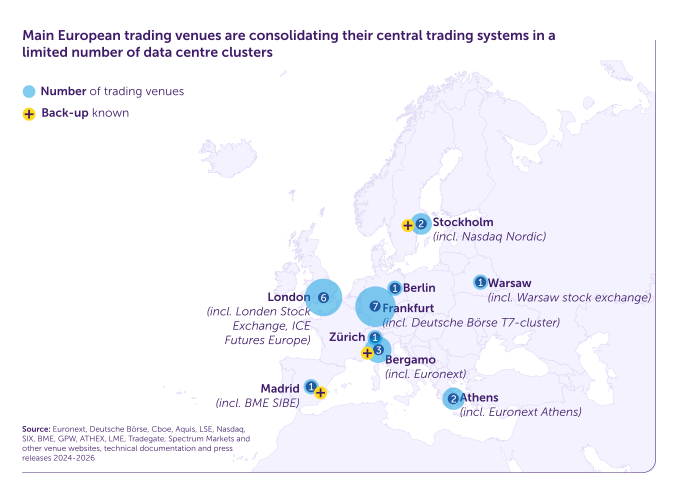
Recent incidents show how a technical malfunction outside the trading process can still have a market-wide eect. In November 2025, futures and options trading on CME was halted for many hours after a cooling installation failed at a third-party data centre operated by CyrusOne. The disruption aected several asset classes and trading platforms that relied on the same infrastructure. The European payment and settlement infrastructure also experienced several disruptions. A hardware failure caused a prolonged outage of T2 in 2025. In June and July 2026, shorter incidents followed a software update and disruptions to the link between T2 and T2S, with delays in payments, settlement windows and liquidity transfers.These incidents illustrate how digitalisation has changed the physical infrastructure behind financial markets. Whereas securities used to be traded on trading floors in cities such as Amsterdam, Paris, London and Frankfurt, order processing is now almost entirely electronic. Trading venues remain geographically dispersed across Europe, but their technical infrastructure is more concentrated. The figure shows that major European trading platforms host their central trading systems in a limited number of data centre clusters, including around London, Frankfurt, Bergamo, Stockholm, Zurich and Madrid.
This physical concentration is partly due to economies of scale and eciency. Concentrating trading infrastructure in a limited number of data centre locations can reduce costs relating to buildings, power, cooling, network connectivity, security and technical management, among other things, by eliminating the need to duplicate these facilities in multiple locations. For example, the central production environment for seven Euronext trading places is located in Bergamo. Key trading infrastructure is also concentrated around Frankfurt, while London forms an important technical cluster where the infrastructure is spread over several data centres in Slough, Docklands and Basildon, among others.
The same economies of scale create physical operational dependencies at the same time. A local disruption in, for example, power supply, cooling, physical data centre infrastructure or network connections can aect multiple trading systems at the same time when they are concentrated in the same location. Backup and disaster recovery locations mitigate this risk, but resilience also depends on sucient geographical separation and a reliable switch to the recovery location.
DORA strengthens the digital resilience of individual institutions and the supervision of critical ICT service providers but does not eliminate this market-wide concentration. Assessing operational risks therefore also requires insight into shared data centres, technology platforms and other interdependencies across the market infrastructure chain.
Asset management
Private credit market – less cause for concern in the Netherlands
- The Dutch private credit market is relatively small (€7.5 billion in 2024.
- The market consists of heterogeneous funds with shared characteristics.
- These funds use little leverage; partly because of this, defaults are limited.
- The range of private investments oered to retail investors is on the rise
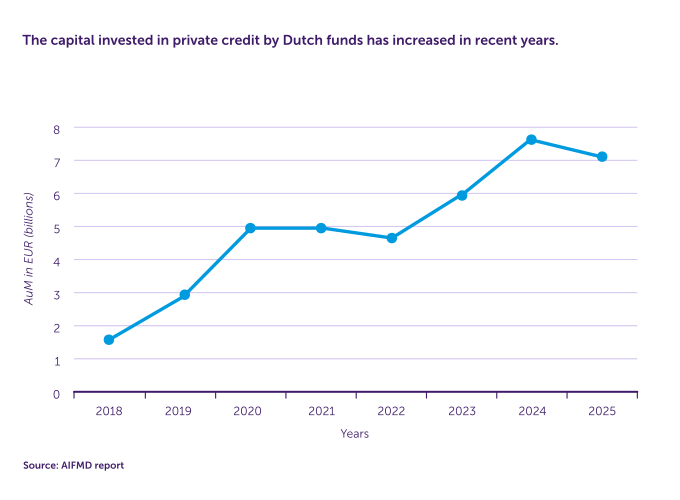
Private credit regularly makes headlines in the financial news. This asset class has emerged as an alternative to bank financing since the 2008 financial crisis. This is due to stricter capital regulation and it has taken off in recent years, particularly in the United States. In the Netherlands, too, capital invested in private credit has increased over time. The expected growth in Europe is partly driven by the developments surrounding the ELTIF regime and the savings and investment union (SIU).In the Netherlands, the private credit market is still relatively small and now consists of 17 managers of about 30 Dutch private credit funds. These funds had €7.5 billion of AuM under management in 2024. That money is mainly lent to Dutch SMEs and Dutch projects are financed with little or no leverage (but possibly with stand-by credit lines).
Internationally, there are concerns about the growth of private credit as an asset class; these concerns focus on the possible impact on financial stability due to the interconnectedness with the banking system, where banks provide leverage to the funds and also finance the same companies. In the Dutch context, these concerns are less pronounced, because banks and private financiers are less intertwined and because the market for private credit in the Netherlands is limited.
The growing supply of private credit funds to retail investors has also drawn the attention of the AFM. Private credit funds tend to have a higher risk profile due to credit risks, information asymmetry, infrequent valuations and liquidity risks, such as liquidity pressure in the event of an interim exit within open-ended structures. Therefore, appropriateness and suitability are important considerations when offering these funds to retail investors. Moreover, with the entry into force of AIFMD II, additional rules for investor protection in open-end private credit funds have come into effect.
Accountancy and reporting
Cyber resilience is an area of concern for the accountancy sector
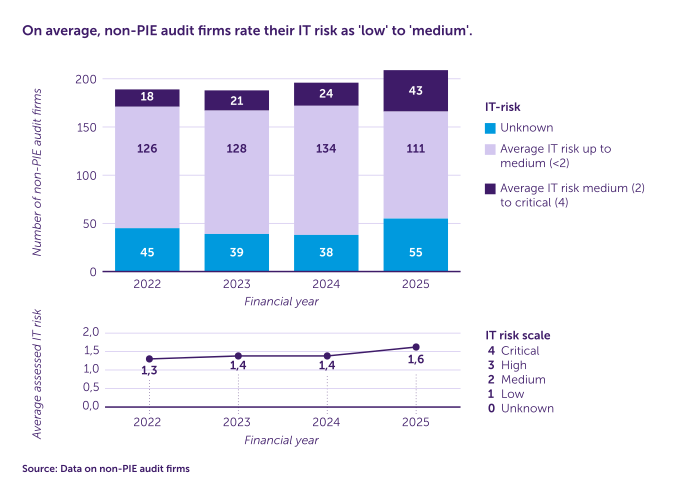
Awareness of the cyber resilience of audit firms is lagging behind, while the number and impact of cyber incidents are increasing. Audit firms hold large amounts of sensitive data and can therefore be an attractive target for cyberattacks. The number and impact of cyber incidents in the financial sector are increasing.75 Figure 5.3 shows the results of AFM analyses of the average IT risk as assessed by non-PIE audit firms. This shows that they assess their IT risk as 'low' to 'medium' on average, ranging from 1.3 in 2022 to 1.6 in 2025 on a scale of 1 (low) to 4 (critical).Furthermore, the IT risk is unknown at a significant number of non-PIE audit firms. These results may indicate that some non-PIE audit firms are insuffciently aware of cyber risks and, as a result, do not take suffcient measures to mitigate these risks. Cyber risks are greater if audit firms use more advanced data analysis tools, do not have their security in order and/or apply long retention periods for source data. The AFM has also conducted an exploratory investigation into the maturity of information security at PIE audit firms. This shows that although there is a solid basis, there are still opportunities for improvement in order to achieve the level of maturity that the AFM expects.
Integrity and criminal behaviour
Public-private cooperation is shifting from information exchange towards the early and joint disruption of fraud chains
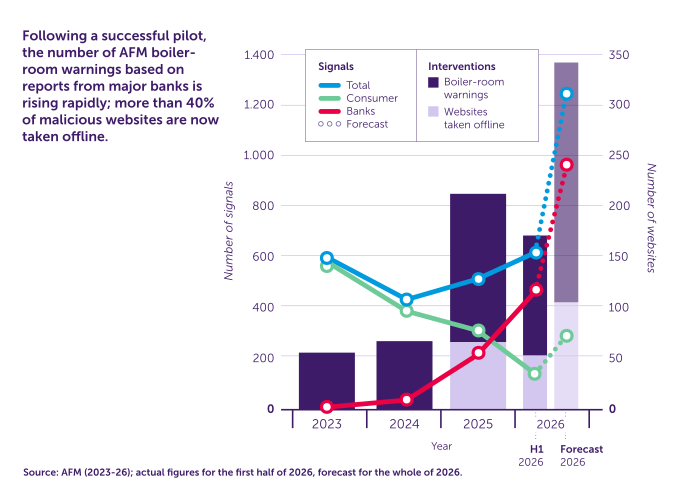
Resilience is increasingly a property of the financial system. Based on this premise, in December 2024 the AFM launched a pilot with a major bank to identify boiler-rooms earlier and tackle them more quickly. These included boiler rooms offering (possibly fictitious) crypto-assets or facilitating speculation in them. Until then, the AFM had mainly responded to reports from consumers (investors), by which point the harm had unfortunately often already occurred and money had been lost. The AFM also received few, if any, reports from banks; taken together, all the reports resulted in only a limited number of public warnings to consumers. The pilot trialled:
- placing warnings on the AFM warning list and on the AFM's checkjeaanbieder.nl website and adding a warning to IOSCO's I-SCAN,
- subsequently blocking URLs;
- and taking websites associated with boiler-room activities offine.
The pilot ran until December 2025. The pilot was assessed as successful and in 2026 the cooperation was expanded to several other major banks. The results underline that a chain-based approach brings together more reports, enables earlier intervention and can limit losses for investors.