
Press release
26/05/26
Financial stability under further pressure due to Iran war
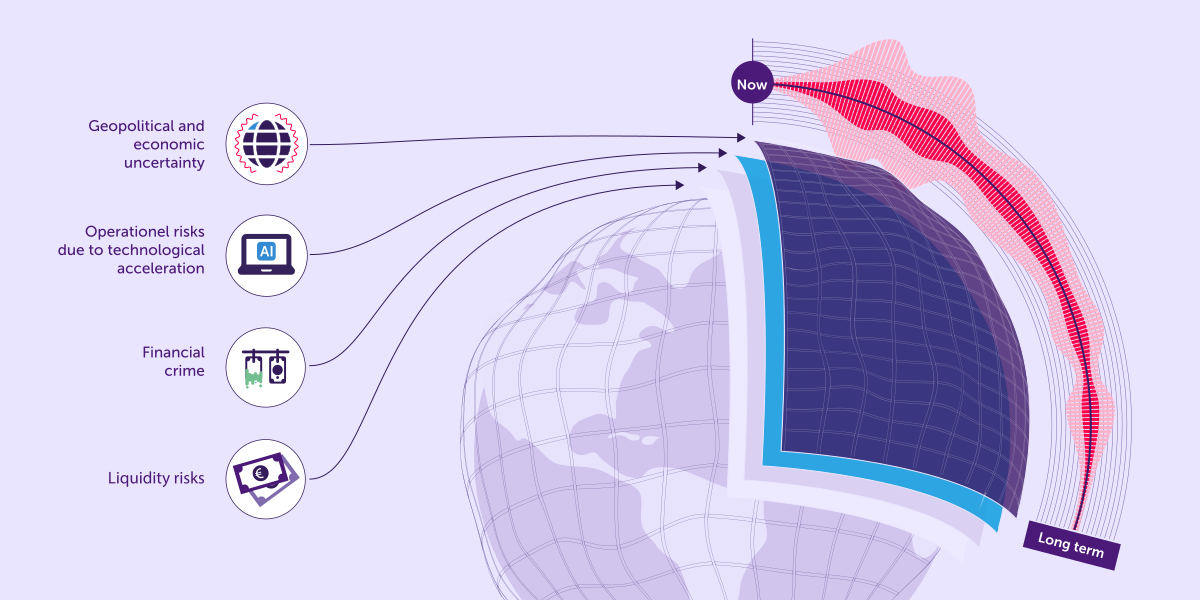
The escalation of the Middle East conflict leaves the global economy in a clearly worse state than previously expected. Higher inflation expectations, lower growth and heightened uncertainty are also affecting the financial sector, according to the annual Financial Stability Report from the Dutch Authority for the Financial Markets (AFM). Financial market volatility has increased, with prices being driven more by short-term sentiment. This means greater valuation, liquidity and operational risks for financial undertakings. The risks to financial stability have consequently increased.
In short
- Structurally higher uncertainty calls for resilience
- Close supervision of volatile gas market
- Businesses and consumers at risk from digital fraud
- Growth in private credit underscores importance of risk management
Structurally higher uncertainty calls for resilience
Higher inflation expectations, slowing economic growth and rising geopolitical uncertainty impact financial stability in various ways. Rising costs and falling purchasing power directly affect the financial position of businesses and households. At the same time, geopolitical tensions increase volatility in financial markets, with wider price fluctuations, a risk of sharp corrections and potential liquidity pressure on financial undertakings. These tensions also heighten the risk of cyberattacks and disruptions to critical infrastructure.Laura van Geest, Chair of the Executive Board of the AFM: “Uncertainty is the new normal. The financial sector and its supervisors need to adapt to this new world. That means looking beyond the familiar priced-in risks and more explicitly factoring in uncertainty that is hard to model.”
Close supervision of volatile gas market
Around the world, oil and gas prices have risen sharply and the gas market has been more volatile since the outbreak of the Middle East war. In addition to physical trading, gas is heavily traded through derivatives, not only by energy companies but also by financial undertakings. Trading in TTF gas derivatives largely takes place in the Netherlands, under the AFM’s supervision. Despite the higher prices and stronger fluctuations, the gas market has continued to function. Trading remains active and price formation appears to be taking place in an orderly manner. As a supervisory authority, the AFM maintains close oversight of transparency, concentration risks and the robustness of trading platforms, particularly at times of heightened geopolitical tension.Businesses and consumers at risk from digital fraud
Digitalisation and the rapid rise of AI are increasing efficiency but also make the sector vulnerable due to its dependence on critical – often non-European – infrastructure. At the same time, cyber risks and AI-driven fraud, such as deepfakes and targeted attacks, are increasing rapidly in scale and complexity. The use of AI in various capital market processes may lead to faster and more uniform market reactions, posing risks to volatility and market integrity, particularly through fully or partly autonomous systems.Digital fraud is also evolving into a structural threat to consumers. Annual losses from investment fraud in the Netherlands are estimated to be around €750 million. Much of this remains below the radar due to low willingness to report and the cross-border nature of online fraud, which primarily takes place through professional-looking platforms, social media and advanced social engineering techniques. This development could undermine confidence in the financial sector.
Growth in private credit underscores the importance of risk management
Although the volume of private credit in the Netherlands is limited at present, it could still pose potential risks to financial stability. Illiquidity, valuation issues and limited transparency could rapidly lead to problems in stress situations, for example due to outflows from unit trusts and forced sales. Moreover, growing interconnectedness with banks and other institutions means shocks can spread more rapidly. The AFM therefore expects asset managers to strengthen their liquidity risk management and providers to carefully assess whether products are suitable for investors, paying specific attention to complexity and limited tradability.
Contact for this article

Charlene Zikmund
charlene.zikmund@afm.nl
+31 6 29 42 08 87
+31 6 29 42 08 87
Would you like to receive the latest news from AFM?
Subscribe to our newsletter, we will keep you up-to-date.